
The diatonic harmonica, celebrated for its distinctive bluesy sound, is traditionally tuned to a major scale, but numerous alternative tuning systems have evolved to cater to different musical styles and player preferences. These tuning systems vary in their note layouts, offering unique advantages and sometimes posing specific challenges. I find these different tuning styles are not known to many. Here, I will try to give some information on these different styles.
Richter Tuning
Richter tuning, named after its creator Joseph Richter in the early 19th century, is the most prevalent tuning system for diatonic harmonicas. Its layout is designed to facilitate playing chords and melodies in a straightforward manner, making it a versatile choice for various musical genres.

This arrangement provides a C major scale with additional notes available through bending, particularly in the draw notes of the first six holes.
Advantages
Versatility: Suitable for a wide range of music genres, including blues, folk, rock, and country.
Chord Play: Enables easy chord playing and rhythmic accompaniment, especially for folk and blues.
Bending Capability: Supports bending on the draw notes (holes 1-6), allowing for expressive, nuanced playing typical in blues and rock.
Accessibility: Ideal for beginners due to its widespread use and the abundance of learning resources.
Disadvantages
Limited Chromaticism: Achieving a full chromatic scale is difficult without advanced techniques like overblowing and bending.
Non-Intuitive Layout: Some notes needed for certain scales or modes are not easily accessible, requiring skill and practice to play fluently.
Richter tuning remains the cornerstone of diatonic harmonica playing, providing a balance of simplicity and expressive potential that appeals to both novices and seasoned players.
Paddy Richter Tuning
Paddy Richter tuning is a modification of the standard Richter tuning, designed specifically to facilitate the playing of folk and Irish music. The key alteration in this tuning is raising the 3 blow note by a whole step. For a C harmonica, this means changing the 3 blow note from G to A. This tuning has full two octaves of suddh swars, Sa, Re, Ga … etc. It allows easy playing of Indian songs based on Bilaval Thaat. Even other songs can easily played using bending in this tuning:

Advantages:
Melodic Playability: The raised 3 blow note (G to A) provides a complete major scale in the middle octave without needing to bend notes, making it easier to play traditional melodies and tunes, particularly those found in Irish and folk music. This is especially good for Indian music.
Ease of Learning: For those who play melodies in the second octave, the Paddy Richter tuning simplifies the layout, allowing for more intuitive and fluid play.
Improved Accessibility: The altered tuning enables easier access to the notes required for common folk tunes, enhancing the instrument’s capability for fast, melodic runs.
Disadvantages:
Blues Playability: The modification makes it less suited for traditional blues music, as the usual bending and note patterns are altered.
Specialization: While it excels in Indian and Irish music, this tuning might not be as versatile for other genres, limiting its appeal to players who need a broader range of musical styles.
Adjustment Required: Players accustomed to standard Richter tuning might need time to adjust to the new note layout, particularly if they frequently use the 3 blow note.
Paddy Richter tuning offers a valuable alternative for harmonica players focused on Indian music, providing a more intuitive layout for melodic play. While it may limit the instrument’s versatility in other genres, it stands out as an excellent choice for musicians seeking to perform traditional tunes with greater ease and fluency.
Country Tuning
Country tuning modifies the Richter tuning by raising the 5 draw note by a half step. For a C harmonica, the draw note on hole 5 changes from F to F#. If we take C as Sa in Indian music then this tuning will give us all the notes of Yaman-Kalyan Thaat (Lydian scale):

Advantages:
Major Scale Emphasis: Makes it easier to play major scales and modes, particularly suited for country music.
Simplified Melody Playing: Facilitates playing melodies that include the F# or Tivra Ma note of the major scale without bending.
Disadvantages:
Blues Limitation: The altered note can disrupt traditional blues playing, making it less suitable for classic blues techniques.
Specialization: Best for specific genres, reducing its versatility compared to Richter tuning.
Melody Maker Tuning
Lee Oskar company merged the Paddy Richter and Country tuning to create the Melody Maker layout. The Melody Maker tuning alters the 3 blow and 5 draw notes to create a complete Lydian scale in the middle register. This layout marks the scale on second position, i.e. 2nd draw note. To get C on first blow note, one should select G scale harmonica:

Advantages:
Melody Playing: Ideal for playing songs in Kalyan Thaat (Lydian scale) without needing to bend notes. This also excellent for pop, jazz, and other melodic genres.
Ease of Use: Simplifies the execution of major scale passages, benefiting less experienced players.
Disadvantages:
Blues Restriction: The altered notes may hinder traditional blues playing. Especially, chord in first position does not sound as good as Richter tuned harmonica.
Specialized Focus: While excellent for melodies, it may not suit players looking for versatility in blues and folk music.
Natural Minor Tuning
Natural minor tuning shifts the notes to form a natural minor scale (Dorian scale). In this scale B, and E notes are flattened. If we take C as Sa, this means Ga and Ni notes are Komal, which is same as the Kafi Thaat. Note that this scale is designated by its second draw scale. You need to use G scale harmonica for getting C in the first blow position:

Advantages:
Minor Key Playability: Optimized for minor key music, providing a full minor scale (Kafi Thaat) without the need for bending.
Harmonic Minor Songs: Facilitates playing folk, classical, and rock songs that are in minor keys.
Disadvantages:
Blues Compromises: Less effective for traditional blues, which often relies on major scale bends.
Genre Limitation: Not as versatile for major key music, making it less flexible for multi-genre performances.
Harmonic Minor Tuning
Harmonic minor tuning is designed to play harmonic minor scales. This scale has E and A notes flattened. In Indian notation with C as Sa, this means Komal Ma and Komal Dha:

This tuning will be useful in some of the music if we start our Sa from some other position. We had touched briefly on this subject of transposition of swar to suit diffirent music briefly in one of my earlier blog. We shall discuss the mapping of Thaat on different tuning scales at a later blog.
Advantages:
Eastern and Classical Music: Suitable for playing music styles that use harmonic minor scales, such as classical and Middle Eastern music.
Distinctive Sound: Offers a unique, exotic sound that is distinct from other tunings.
Disadvantages:
Less Common Use: Less versatile for Western popular music, which predominantly uses major and natural minor scales.
Complex Learning Curve: Requires players to adapt to a different note layout, which can be challenging.
Circular Tuning
All the tuning we discussed so far is based on the Richter tuning. There are many other type that are entirely different from the Richter tuning. Circular tuning gives all base tones arranged in sequence. The idea is that other semitones the player can produce by bending to get a full chromatic range of notes.

Layout of circular tuning is non-intuitive and not popular. This layout has a very long learning curve.
Solo Tuning
Solo tuning address the drawback of circular tuning by creating a repeating pattern of notes that repeats after four hole positions. This is most popular tuning style for chromatic harmonica. Normally the chromatic harmonicas add two more holes to cover complete three octaves. Some cover four octaves with sixteen holes.

Advantages:
The repeating note pattern is intuitive and easy to pickup.
As the same note is available after four holes, it allows for octave playing. Octave playing is a special type of tongue blocking technique to play two notes together separated by an octave to create a rich tone.
Disadvantages:
The note layout is not suitable for blues type of music. Also the layout is not suitable for chord playing other than the first position.
Orchestra Tuning of Harmonica
Orchestra tuning, also known as “Orchestra S” tuning, is a unique diatonic harmonica tuning system designed to provide a fully chromatic scale without the need for bending or overblowing. It achieves this by rearranging the notes in a manner that differs significantly from the traditional Richter tuning. This tuning is also popular in the chromatic harmonicas:

Advantages:
Chromatic Capability: Allows for the complete chromatic scale, enabling the player to perform in any key or mode without complex techniques like bending.
Ease of Play: Facilitates smoother transitions between notes, making it ideal for playing intricate melodies and classical music pieces.
Adaptability: Suitable for orchestral and ensemble settings, where the ability to play accurately in any key is essential.
Disadvantages:
Learning Curve: The non-standard note layout can be challenging for players accustomed to traditional Richter tuning, requiring time and practice to master.
Reduced Blues Expression: Lacks the inherent bluesy feel and bending capabilities of the Richter-tuned harmonica, making it less suitable for blues and folk genres.
Specialization: Best suited for classical and orchestral music, which may limit its appeal for players focused on popular music styles.
In summary, Orchestra tuning offers a versatile and chromatic alternative to traditional diatonic harmonica tunings, making it a valuable tool for musicians aiming to perform complex and varied repertoires, especially in formal musical settings.
Easy Diatonic (EDHarmonica)
Easy Diatonic tuning aims to extend the concept of solo tuning by providing repeating note layout covering full three octave in 10 holes. In doing so, this layout does not have the F note. The F note is one semi-tone above E. The player needs to get F and other semi-tones by bending.
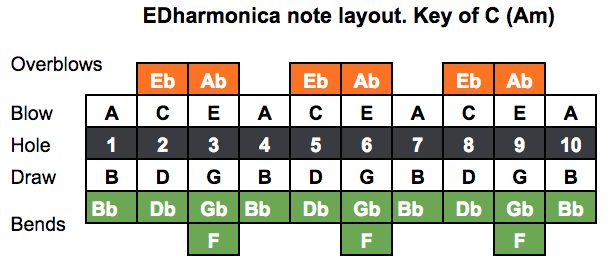
To learn the entire note layout of your EDharmonica you only have to remember the pattern on the first three holes.EDharmonica enables beginners to achieve quick results and offers extraordinary possibilities to advanced harmonica players.
Major Cross Tuning
The MAJOR CROSS tuning, developed by Tony Eyers, allows a major scale to be played in second (or cross) position without any bending. While many players use second position, they often find traditional tunes challenging, due to the bending/overblowing needed for some notes.

Power Bender
The PowerBender tuning builds on the best parts of the traditional Richter Tuning, while altering the scale to make the real juicy and important notes much easier to obtain throughout the whole three octave range. As the name suggests all draw notes bend everywhere, holes 1-10!

Wilde Tuning
This tuning was created by Will Wilde specifically to play rock music. According to its creator, “I designed the Wilde tuning specifically for playing blues rock and hard rock music. As much as I love Richter tuning, I have always found it somewhat frustrating when it comes to playing ‘guitar-like’ minor pentatonic/ blues licks in the upper octave. The Wilde tuning addresses all of the frustrations I had with Richter tuning, whilst still retaining the familiar bluesy feel of classic second position harmonica playing that we all know and love.”

Diatonic harmonica tuning systems each offer distinct advantages and pose unique challenges, catering to various musical styles and player needs. The Richter tuning remains the most versatile and widely used, while specialized tunings like Country, Natural Minor, Harmonic Minor, and Melody Maker provide targeted benefits for specific genres. Understanding these tuning systems allows harmonica players to choose the most suitable instrument for their musical goals, enhancing their ability to express diverse